Creating Anti-Capitalist Experiments, Projects, Campaigns
For small organizations, or committees or teams within a larger formation, a full blown strategy is not always appropriate either for time or task reasons. Plus, with conditions changing as quickly as they do, full strategies can become outdated quickly. What is offered below is a method of using the form of experiments to create interventions that give a team a chance to build consensus on what “anti-capitalism,” “socialism,” “antiracism,” or “antimperialism” looks like and practice a relatively simple dialectic. Even if an organization does have the capacity to create a large strategy, it can still be a series of smaller experiments building to a larger one using much of the process below.
Strategies Carry Markers of Our Politics
Executed with intention and some discipline, our organizational tactics can be rooted in an experiment that explores a strategic, or big picture, question. By “experiment,” I mean a tactic or project based on an “if/then” statement. The quality of the hypothesis, assuming good faith effort, is determined by comparing it to the actual result. Of course, strategy, like all social activity, is not politically neutral. The objectives, hypotheses, tactics, reflect embedded assumptions rooted in a political tendency or tradition. Thus, attempting to create a strategic experiment provides an opportunity to discuss, build consensus and explore contradictions in our organizational politics.
Moving towards consensus, a first question might be, “What are the signs or markers of our anti-capitalism, for example, on this project?” But, in order for our politics to be anti-capitalist, it helps to agree on some of capitalism’s key components. French Socialist, Andres Gorz, in “A Radical Strategy for Labor,” came up with the term, non-reformist reforms to guide socialist/anti-capitalist union behavior in France and pointed to a few characteristics of capitalism including (a) accumulating capital, (b) using the State as a weapon to reproduce power, and (c) centralizing authority. So, anti-capitalist interventions do at least two things in this formulation, they constrain the power of capital and/or the state and they broaden democratic control. By expanding democratic control, or decentralizing power, Gorz is looking for the group to build a separate platform of power from which to impact the situation.
Pulling from Black nationalist, Pan-Afrikanist, anti-patriarchal socialism, below I offer sample anti-capitalist criteria using these traditions. This way I can assess if the experiment is anti-capitalist by those standards. Organizations will, of course, want to discuss their own specific anti-capitalist politics and the corresponding criteria. Agreeing on these criteria is a method to build consensus on the politics of our group, but how do we determine the objective(s) of our strategy once we’ve agreed on the anti-capitalist criteria? Since funding is from the capitalist class, it can’t be easily supported by capital and be anti-capitalist, right? So, the following method is an attempt to create anti-capitalist objectives and we may have to consider that the conditions at our job do not necessarily allow our work to be anti-capitalist or we have to really put something at risk for it to be so.
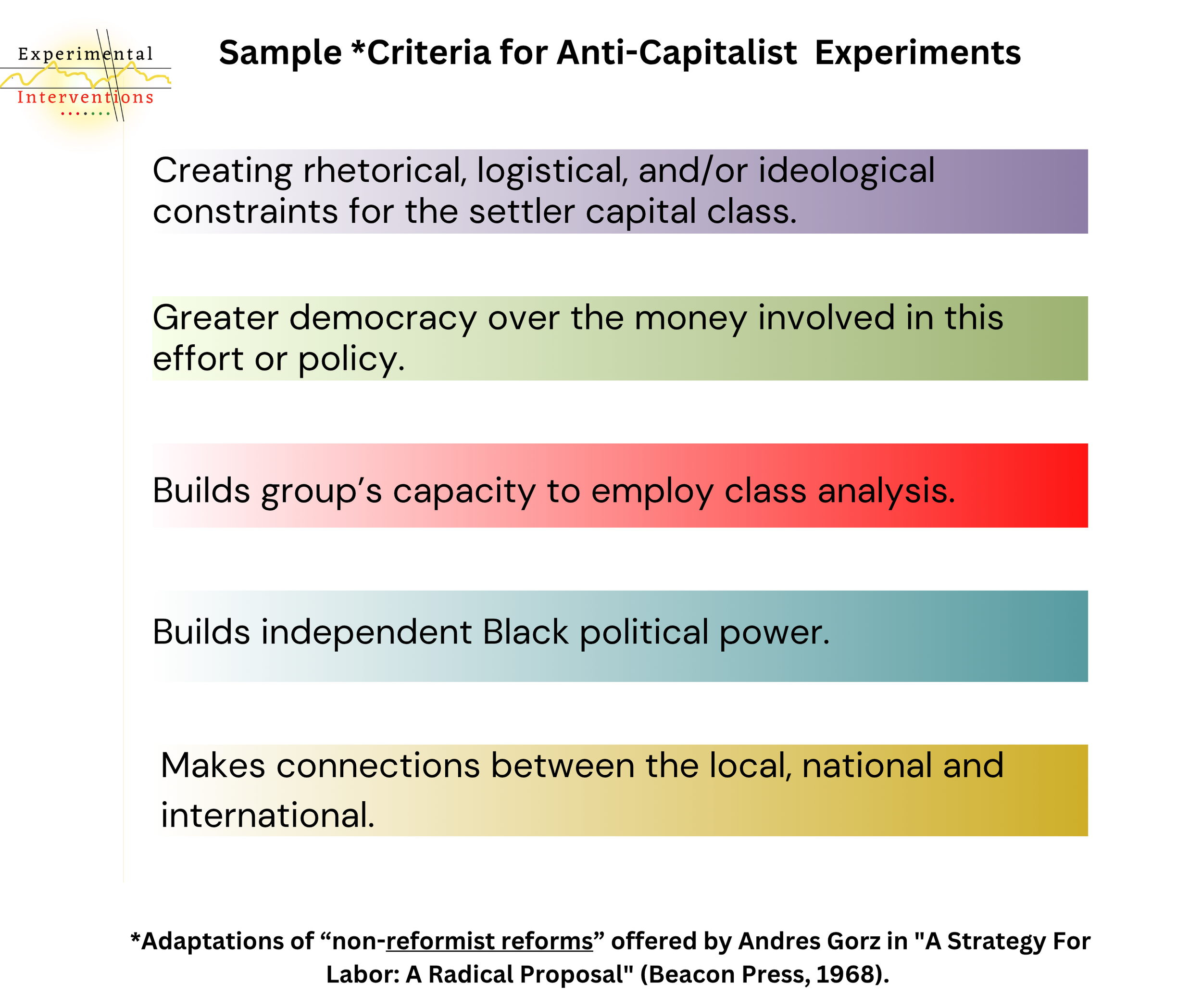
sample criteria for anti-capitalist interventions
Liberal/nonprofit organizational politics encourage us to pick a mission related, achievable objective that meets a funder’s, or a potential funder’s, interest. In a socialist model, particularly one influenced by Marxism, we look at the “material conditions” impacting the Black working classes as the starting point to create an objective. The method I am offering below is adapted from Paulo Freire’s “Pedagogy of the Oppressed.”
Using Pedagogy of the Oppressed to Create Anti-Capitalist Strategic Objectives
In Pedagogy of the Oppressed, Freire’s method to select a key objective(s) is based on “themes,” local, regional, national, and universal. Local themes are the incidents happening immediately around us, and universal themes for Freire are ideas like “domination” but here I insert terms that, for me, feel more immediate and grounded such as “racial capitalism,” “imperialism,” “climate change,” and so on. Freire even goes so far as to name the epochal themes, or the themes of the era we are in, and this could also be a point of discussion for a group. However, if time is limited, this is a step I think we can skip. What’s important is that the themes are the basis of our objectives.
Once the themes are named, we can determine the theme or family of themes that we most want to address and then decide what we think is the essence underneath the one theme or the essence tying them all together. This essence is what Freire calls the “limit-condition” or the crux of the oppression we are confronting. The opposite of this limit, what we hope to realize, becomes our objective. Freire calls this the “unrealized feasibility” and in the Vietnamese historical materialist philosophical approach it is considered the “possibility” that sits within the “reality.” My recommendation is to select an objective or possibility that can be achieved in one to two years.
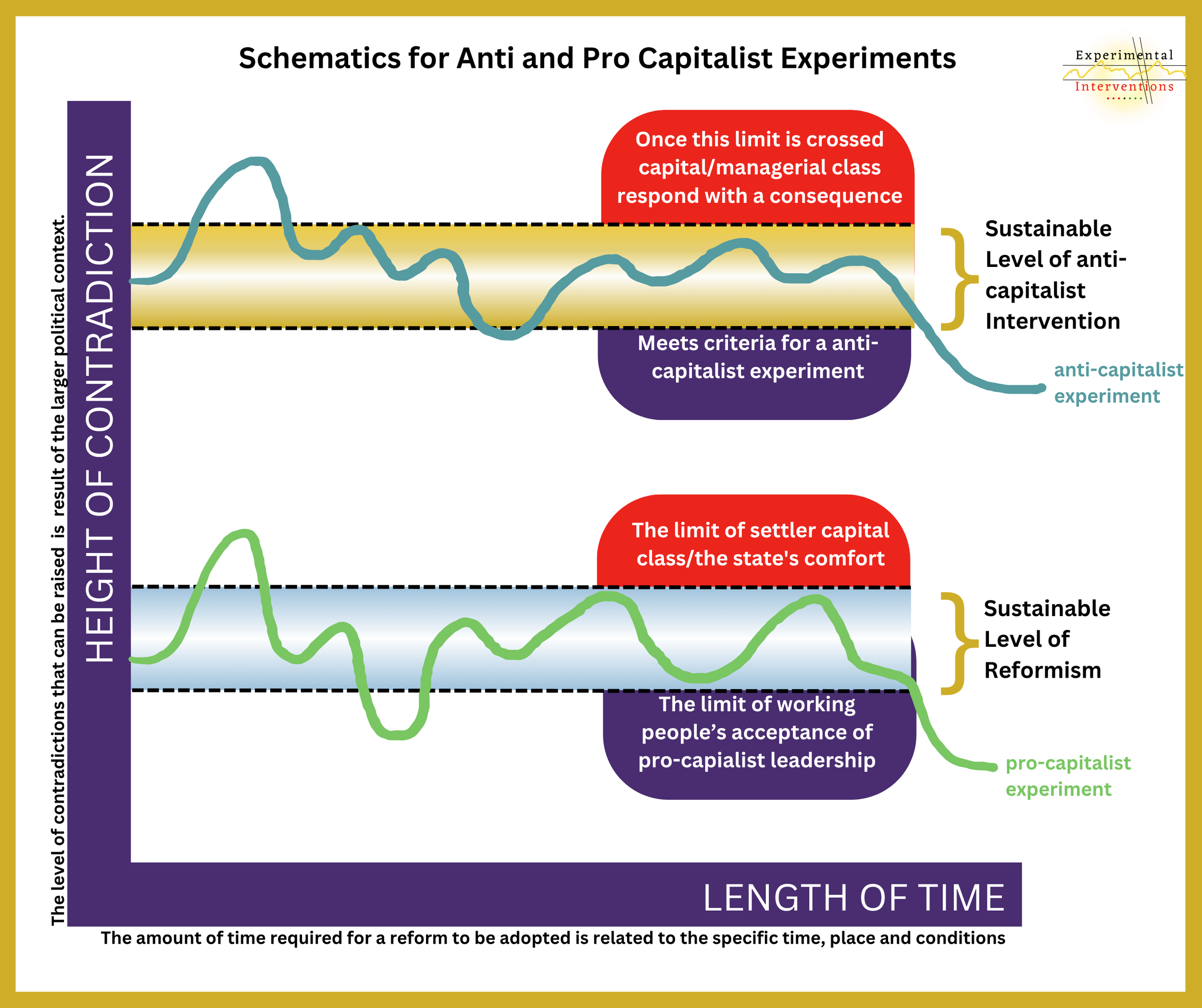
Anti-Capitalism Is Disruptive
The next step (above image) adapts the Adaptive Leadership model and asks us to discuss the level of disruption we are seeking to create as a result of our anti-capitalist strategy, including general ideas around a lower threshold and an upper threshold of disruption. The point here is that, if our tactics exceed the upper threshold (the top of the graph above), the capital and professional classes will experience a level of tension above which they are comfortable, and will respond by trying to shut it down and punish. If the outcome of our strategy trends toward the lower level (the bottom of the graph above) of tension, it means that our selected strategy will not raise enough tension to get our people’s attention which is needed in order to bring more people to anti-capitalist work. The long squiggly line above is the experiment and so we can plan to bring tensions up and down over the course of the intervention. These conversations and determinations might allow a group to get clearer about one another’s politics, build consensus, and come closer together, which is another dynamic anti-capitalism requires. The point here is not to get too exacting about upper and lower thresholds, that is is just a visual aid, but just to spend time collectively discussing the level and kind of disruption of the experiment, strategy or campaign.
With these questions answered, we can develop our if/then statement that expresses our political principles, meets the objective, and reflects the level of disruption we want to create. Once we set an overall time period and clear success indicators, we have our anti-capitalist experiment. My next post will be provide more specifics on that process, but anyone can start with is an if/then statement, indicators of success, a description of the level of tension that is being pursued and the group’s markers of anti-capitalism.
If you found this post helpful and you would like to buy me a coffee, it is greatly appreciated. This work does take some time and so your support helps it continue and even increase in regularity.