Connecting Marimba Ani’s “Yurugu” to Domenico Losurdo’s “Class struggle”.
Last year, I read a book that’s really influenced my thinking on the phrase “class struggle”: Domenico Losurdo’s “Class Struggle: A Political and Philosophical History.” In this post, I am going to try to explain how I understand its core idea and method to add some more clarity and expansiveness to the term “class struggle.” Although it may seem foreign, socialist, or white, we often hear or use “class” in terms of “the Black middle class” or “the working class. So, its not really a foreign term. In Losurdo’s frame, class is a general term for groups of people with shared relationships to way the economy and society is produced and reproduced. Class struggle, in Losurdo’s use of the term, is how groups contest/respond to others on the opposite side of that relationship to the means of economic and social production. I think Black people may resist the term because settler White liberals/socialists, usually men in my experience, offer “class” as the key problem in replacing “race” or “gender.” Losurdo argues they misunderstand the term. Marx and Engels talked of class struggles to emphasize that multiple class struggles were taking place at once.
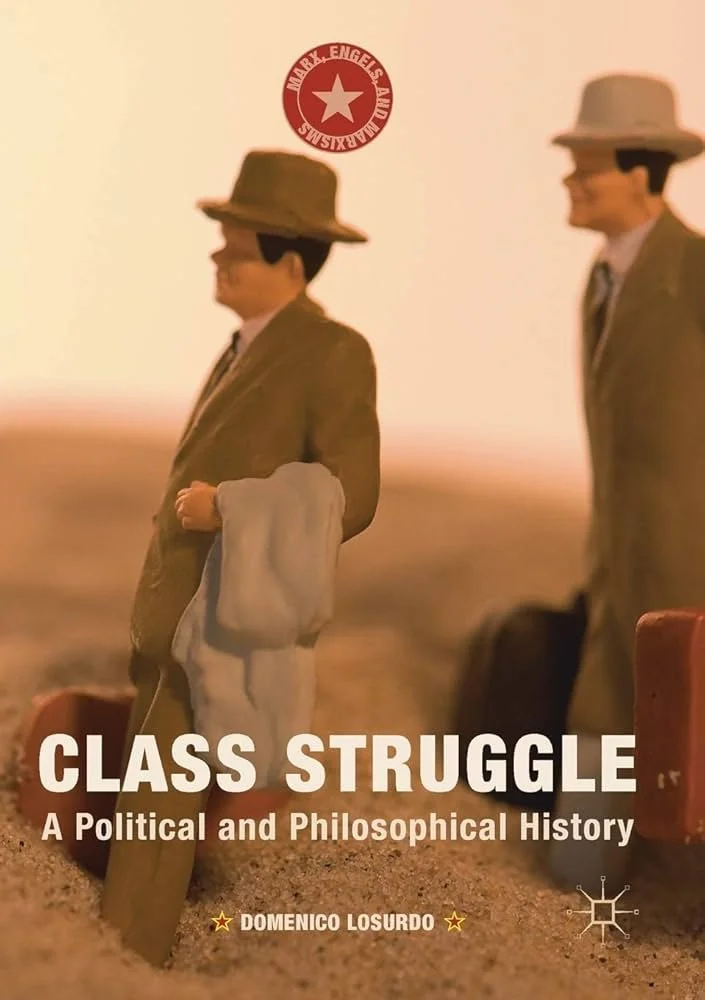
A picture of two white men in suits, carrying brief cases and walking through what appears to be sand.
So, in Losurdo’s use of the idea, it is really more flexible than this and a tool we can put in our anti-racial-capitalist or Ujamaa or even spiritual toolbox. I say spiritual because even that spiritual work will benefit different classes at different times or the same time to different degrees depending on what it does and does not do, what it does and does not say. We see this clearly in the case of Zionism which argues for a particular class, Jewish people, and their right to a certain territory. My prayer is that this post contributes to Black people’s interest in using class analysis as a tool in an even more intentional way for Black people’s struggle for self-determination.
Again, in Losurdo’s framing, class can include national groups like Iran and the U.S./Israel (the ruling classes of which are being referred to as the Epstein class), as well as Black/African people in the U.S. understood as an internal colony and Euro Americans as settler colonialists. There are also classes within these larger classes like the Black upper working class or European settler capital class. “Class struggles” in this sense, is the aggregate of what a class is doing for its own progress and reproduction, but also the struggle within the class to determine its direction. In this understanding, class struggle are what is defining the society and shaping history, whether we are checking for it or not.
In this sense, a key component of U.S. racial-capitalism is a Euro settler capital class struggling to maintain full dominance over the masses of Black/African people, a war as it is explained by the Black Alliance for Peace (of which I am a member), not only in the U.S. but around the world. This war includes the Euro settler capital class recruiting and getting partnership with the general European population in the U.S. and, in different ways, partnering with elements of Black/African people in the upper working or managerial classes, not only in the U.S. but in other countries as well. In terms of the Black liberation struggle, the primary target and sufferer are the masses of wage earning and non working Black people, even more so outside of this country than in it. This is a struggle for the capital class in that the outcome is not assured and it doesn’t always work out as they want it to as can be seen in long histories of resistance and the revolutions that are successfully waged. This settler capital class struggle is the general story we know of the European struggle against Black self-determination.
However, telling the general story only gets us but so far. The general story, or what Marx called “the abstract” or Freire called the “universal theme” points us to where to look to try and understand the specifics of our current situation and where it is going, but without digging into the specifics we will end up with the same analysis regardless of the time and place. Looking at the specific aspects of what is going on in particular time and place and relating it to this larger narrative of war and what Marimba Ani calls in “Yurugu: An African Centered Critique of European Thought and Behavior,” the MAAFA, or great tragedy, lets us reinterpret the local and connect it to the general story or the abstract princple. These details, in turn, inform how we understand the big picture. Although she doesn’t use these terms and doesn’t speak to the dominant classes within European people, Ani, is describing European class struggle to define the world in their image. Her analysis of European thought and behavior, is a form of class analysis in terms of social production and reproduction as well as an expression of class struggle, because Ani is fighting on behalf of African people.
In my next post, I will look at the framing of “the arts” as a form of European capital class struggle. How this notion of “the arts” has a big impact on what kinds of Black creative activity can receive tax protected dollars as well as how much it can receive and how does that influence our cultural practices.
If you like what you’ve read and are able to financially support this work by “buying me a coffee,” it is greatly appreciated!
Double-click to edit...